Life is always worth living when a person keeps alive their capacity to appreciate what the world has to offer. Julian Baggini


Reflections and observations on the expatriate experience from an American scientist living and working in the Netherlands.
Life is always worth living when a person keeps alive their capacity to appreciate what the world has to offer. Julian Baggini
 I hit the road early, headed south into London for three sets of investor meetings. I took the bus / train / tube combination so that I’d have some time to work along the way, consolidating notes and slides, preparing for questions.
I also enjoyed an essay in the Times describing the arrival of American production workers in the small Italian town of Melfi, where the Fiat plant is being converted to make Jeeps. A cross-cultural specialist was brought in to teach the autoworkers about dealing with Americans: he summed the differences up as the Three C’s:
 And, he reminded them, remember that You’re Italians. No one else is so skillful at turning a crisis into a party. Ah, Europe.
The meetings were challenging: while I am aces when it comes to managing the project and recruiting resources, planning and motivating, I can still get twisted up separating pre-market from in-market debates. We’re setting up a pilot production facility to make units for regulatory and clinical trials, all good. But then the conversation veered:
“Can that facility be transferred directly to a final manufacturer without disturbing the CE Mark?” Yes, we’ve planned for that.
“How many consumable units could you potentially make from that facility?” Perhaps 5000 per year.
“And if you receive 1 gbp profit per consumable unit, your net revenues would be £5000 for that line?”
The truth, of course, is that we would only seed the market to demonstrate update from that line: real revenues would come from licensing to a global manufacturer / distributor. But until the questions hit, the answers aren’t at the tip of my tongue.
I know the limits of what I do well; we’ll hire someone with solid in-market experience to extract the value from any business I start.


London was otherwise beautiful: warm and sunny for conference calls in the park. I did some shopping along Oxford Street, learned that I may aspire to Selfridges but am more comfortable in Debenhams. Then the train back to the bus back to the car in Cambridge, food shopping, gas, ‘aim south and hit the gas at 7 pm.
I was back in Bournemouth just before nightfall. I pulled onto the East Cliff to look for the Branzilla, but there was nothing to see anywhere along the coast.


‘But there was still some wonderful moonlight reflecting over the sea.
The Fiesta’s windshield was hit by a rock a couple of weeks ago. There was a sharp crack against the passenger glass and a star, rapidly expanding to a hooked crack. I’d been charged 600 euros the last time the windshield needed replacing, and a quick call to two UK shops yielded estimates up from £600.
An autoglass repair truck along the motorway told me that I should be able to fix it for less than £250, and I did locate a Poole glass company that would do it for £236. They dropped through early this morning and fixed it in about an hour.


So, ‘back on the road, with cash to spare, into the weekend. There should be time for cliff walks, London on Sunday for the Matisse exhibit, and back to the phones Monday morning.
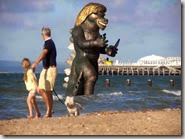
A flaxen-maned sea creature, two stories tall, has waded ashore in Bournemouth this week. All I can say is that it wasn’t there on Sunday…
The monster was made personal in the spirit of Richard Branson, put up by Virgin Media as part of a new publicity campaign. It will undoubtedly travel from beach to beach around Britain this summer before, in all likelihood, heading to permanent repose on Necker Island.
It’s also kind of cool: I hope it stays a couple of days until I get back into town to have a look on Friday.
The notion of personalized monsters got me thinking about the converse: the sort imagined by WH Auden in The Ascent of F6. In the play, a group of climbers ascends a haunted mountain, where an embodiment of each person’s hidden flaws kills them, one by one.
The Guardian stuck a similar theme in an article about how people form their personal values. The author suggested two principle origins, one based in history (shifting baseline syndrome: We perceive the circumstances of our youth as normal and unexceptional) and one based in environment (values ratchet: We are shaped by accepted social norms and governmental policies around us).
Nostalgia and environment, together, drop people along a spectrum of value types, ranging from Intrinsic (high levels of self-acceptance, strong bonds of intimacy and a powerful desire to help others) to Extrinsic (Greater need for external validation, seek financial rewards and power, more competitive against others).
The paper holds that we’re currently in an era dominated by Extrinsic values. It is both created by the political dominance of conservative policies and feeds back to reinforce them. Thus  inequality, intolerance, environmental degradation, and social injustice all increase as opposition withers.
Although I’m sympathetic to the Guardian’s conclusion (the world would, indeed be a better place if we were nicer to each other), I think that the argument used to get there is very forced. In particular, I disagree that personal values are so easily shaped by perceived historical and political norms.
What, then, does explain the prevalence of Extrinsic personal values, selfishness and intolerance, and the corresponding decline of social cooperation, inclusiveness, and mutual aid?
I think that the key is that people act defensively when they feel threatened: they protect their own interests and dismiss other people’s, gravitating towards Extrinsic behaviours.
Personal circumstances such as aging, job loss, weakened relationships, financial or health worries can trigger extrinsic behaviours. So, more distantly, are perceived dangers of crime, terrorism, deficits, inflation or immigration.
As can uncertainty and isolation, two snares waiting to trap expats and entrepreneurs.
Success as an expatriate or an entrepreneur requires Intrinsic values: tolerant and cooperative interpersonal and social skills. Adoption of Extrinsic personal values  undermines necessary attitudes and relationships.
So, the danger isn’t, as suggested by the Guardian, in the way politics or media foster Extrinsic values, putting human hair onto the monster. The danger comes from inside each of us, is in how we regard our history and context, keeping our inner Branzilla at bay.
In the words of the Cherokee, it is determined by the wolf we each choose to feed.
