‘A still evening along Maastricht’s waterway.


Reflections and observations on the expatriate experience from an American scientist living and working in the Netherlands.
‘A still evening along Maastricht’s waterway.
 In America, a Pot Pie is home-cooked fast-food. They cost less than a dollar from Safeway, rendered into reliably binary choices of Chicken or Beef, sold under comfortable Stouffer and Callender brands, we always had several in the freezer. When evenings were short and busy, they were a simple dinner solution. Just toss one onto a tray, bake at 400F for 45 minutes, and up-end onto a plate for the kids to attack.
 Our British brothers have a long prior tradition of savoury pies, staple on home and pub tables. ‘Steak and Guinness’ is the classic variety, with a lighter, layered crust and slow-cooked meat and cheese. At home, Fish Pie and Shepherd’s Pie, with potatoes often standing in for pastry crust, is common. Simpler in concept, but I admit that I have never been able to master preparing either one.
I do somewhat better with Cornish Pasty: Cut a round of biscuit dough, add a spoonful of seasoned meat & veg filling , fold and bake.
Then there are the French cousins.
 Tourtière come to mind, although these are technically not French at all, rather game pies originating in Quebec. Quiche, better known, is more of an egg-based tart.
En croûte, ‘in a pastry crust’, is the more  Continental form of savoury pies. Generally a shortcrust pastry wrapped around a filling, the most familiar variety is Boeuf en croûte, nephew to the grander Beef Wellington.
But other fillings can be used, and I took an interest in Salmon en croûte as a way to dress up some fresh seafood fillets.
I have gotten good at hand-mixing shortcrust pastry, sifting the butter and flour through my fingers to a cornmeal consistency, adding a touch of water to form a fragile dough, finally refrigerating without overworking.
Once rolled out to a £1 coin thickness, build the filling in the center.
It’s simply the two seasoned filets laid over one another, with a layer of spinach, nuts, and herbs sandwiched between.
The whole affair gets wrapped, turned, and sealed: plan for getting single-layer seams rather than overlapping doubles so that the crust isn’t thick and undercooked along the edges.
Brush with egg and bake at 400F for a half hour. The result, once its rested, is really nice: a light crust,, moist salmon, and a very attractive presentation.

It kept well for a couple of days in the ‘fridge and reheats in a slow oven (microwaving makes the crust soggy).

A sunrise photo, not a sunset, as I struck out from Caversham on Monday morning. There was just a single ray of the rising sun probing ahead to the salmon glow from the east, marking the track into the morning, into the week.
Lots of road time and phone calls, but ending with good success on the business side of things. I’ve been trying to catch up with end-of-quarter accounting and academic reviews, even stepping away during the evenings to do some walking and cooking.
Among three dishes tried, I would say that one worked.
The butcher received a shipment of Dorset Goat, which I’ve never tried to cook. Use it as a substitute for lamb, especially in curry, my butcher suggested, be sure to braise it slowly. I opted for a Thai-inspired Kelantan, which necessitated some hunting at Tesco for tamarind and lemongrass.
The recipe was straightforward: rub the marinade into the diced meat, assemble a spice paste, and braise the whole thing in coconut milk in a slow oven.


The result was good, but not spectacular. The meat reduces a lot from beef-sized stew chunks to curled morsels without giving a lot of flavour to the broth. Serve over rice with a strong green side vegetable.
Similarly, an attempt to make a roast duck leg dish failed to impress.  Usually the cut needs to be chilled with a rub and then cooked slowly to bring the meat off the bone (duck confit): I mixed the finished meat and spices into a red-wine risotto.
Failure on both counts, I’m afraid. The meat was tough and unpleasant after cooking, and the starch in the risotto is a bad combination with the sweetness of red wine. I’m going back to duck breast and to white-wine versions, evermore.
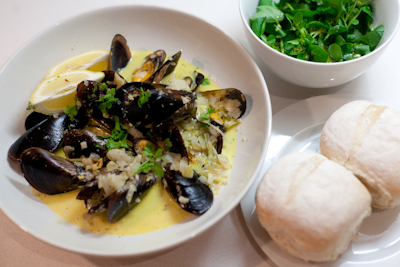 What did work well was a white-wine pot of mussels,. I’m not usually a fan of the Hairy Bikers recipes, but this one was a solid take on the Belgian-style moules. The w.wezen and I added a bit of crème fraiche to keep it from getting too sweet and a yellow onion to make the broth stronger than with the recommended leeks. ‘agreed that this is a keeper.
Cooking note: Any recipe in Great Britain that requires an oven has instructions that specifies a Gas Mark setting. Its a mysterious concept to Americans, an integer number from one to nine.
Introduced for using Regulo Gas Cookers in the 1940’s, the value starts at 275 and increases by 25 F with each Mark (so Gas Mark 3 is 325F).
This is different than the Thermostat (Th) integer scale used in France (starts at 100F and increases by 50F at each step) and the Stufe scale in Germany, which begins at 150 C and increases by 25C at each unit increment.


