


…and, ’hard to believe, but this is blog post number #1000.

Reflections and observations on the expatriate experience from an American scientist living and working in the Netherlands.
…and, ’hard to believe, but this is blog post number #1000.
 I was discouraged before I arrived at the empty tracks at King’s Cross station. I’d been going flat out for a week since returning from the US: two teaching days to finish, investor meetings in London, calls on several projects backed up, the end-of-month bookkeeping waiting for attention.
I put my lists together and pounded through the tasks one by one, the momentum of crossing things off building an illusion of getting things done. By yesterday I thought I was well on top of things.
In reality, I was minimally prepared and pretty well worn though when I reached London for the day’s meetings. The Monday morning messages were the first sign: email is always always sticky, in that answers tend to generate comments rather than closure, but this time there were more questions and issues than usual. A routine trip to St. John’s to pick up the mail got tangled in cross-town traffic that held me to less than a block’s progress in half an hour. The trains ran slow; the news paper had more bad news about Afghanistan where my son is deployed. I know he’s okay, but it’s a worry.
The Board meeting probably lasted twice as long as it needed to, and we missed talking about several key issues. In hindsight, I didn’t have my proposals framed up or my arguments rehearsed, so we wandered around some key issues instead of deciding them. On the Tube, thinking back, there’s really a pattern forming: I haven’t been focused, crisp, prepared, on top of the best game that I know how to play. I was just sliding by: getting things done, but not done well.
There’s a ripple to this. Tasks have to be redone, supplemental questions need answering. The interpersonal dynamics shift, confidence ebbs. I was reading an article last week by Megan Fitzgerald about how lack of confidence shows through to others:
It was a menu of my Monday.
There’s not much to do except to dust off and get back into the scrum. A bit of sleep, a time-out to review, a quick affirmation of the many things that are still going right.
I can (still) do this.
 The Institute for Public Policy Research, a progressive UK think-tank, issued a report last week describing how Britain should shape it’s future economy. It’s interesting reading, and the recommendations probably apply to most 1st-world economies.
Globalisation is the ongoing process by which territorial boundaries and national states lose their hold over economy, politics, and culture. Luke Martell reviewed the various intellectual camps, ranging from hyperglobalists (States wither away because the movement of money, technology, and media can’t be controlled by political institutions) to global skeptics (National identities have a history and a hold on the popular imagination that global identities cannot replace, even though global products and ideas seep in). But they disagree only about the pace of change, not it’s influence on modern life.
Nor is there much disagreement that the process has been socially disruptive, in at least four areas:
The IPPR report notes that globalization and it’s attendant disruption is not new. The first wave was the voyages of exploration and the rise of merchant states like the Dutch, Portuguese in the 15th-17th centuries. The second wave was the rise of global military and economic powers, the British and Americans, in the 19th and 20th centuries. The third wave will see the emergence of emerging markets, like the much-hyped BRICs (Brazil,Russia, India, China) feeding consumer markets in the established economies.
Economies can’t just consume, though: they must create something that other’s want in order to thrive. The report returns to Porter’s ideas of competitive advantage and suggests that their relative advantages in the third wave parse out like this:
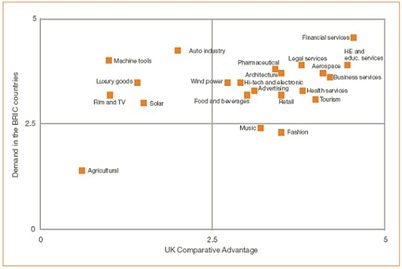
Their conclusion is As a relatively highly-skilled medium-sized economy with a comparative advantage in a number of high-value sectors, the UK has the potential to benefit significantly from deep integration with the global economy. In sectors such as financial and business services, pharmaceuticals, aerospace, education and health services, green technology, hi-tech and electronic industries and tourism, increasing global demand can help create jobs and opportunities in the UK.
But, while Europe can compete in the upper right, the clear winners will lie to the lower right. And, although I agree with the analysis, this is where the recommendations falter a bit. Is the future really just fashion and music?
