Today must be the beginning of Christmas.
Or so it seems in Maastricht.


Reflections and observations on the expatriate experience from an American scientist living and working in the Netherlands.
Today must be the beginning of Christmas.
Or so it seems in Maastricht.
 “Dave, a Board meeting is not a milestone review,” the Chairman gently chided. “They are there to advise, not to judge.”
We walked through the consequences together: a higher-level agenda, more focus on financial performance, less detail on development, questions phrased as propositions, a single-page operating summary.
Yet another way of doing business.
The seamless hierarchy of business organizations suggests that every manager understands the detail of what people beneath them are doing. It implies that managers at all levels differ in the quality, but not the type, of their reviews and presentations.
Employees earn promotions based on performance: applying knowledge, leveraging contacts, and gaining experience that qualifies them for the next level of leadership. A research manager will have successfully innovated; a research director will have completed several projects. At each level, new skills (budgeting, market analysis) and processes (financial reporting, disciplinary rules) are added.
And so, there was a straight progression from scientist to director. Department meetings were large versions of project meetings. And everyone there shared a vocabulary and design model; everyone understood the company’s expectations and the customer’s needs.
We told similar stories. We lived by stage-gate reviews.
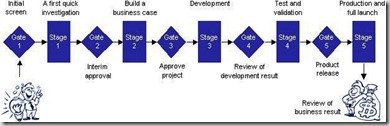
And it defined how I did my job: I knew the format of the weekly milestones list and how to frame a goal. There was a particular report outline and presentation template that spoke to my engineering audience, much like scientific papers and conferences fit diverse information to an expected style.
This changed a lot when I became a general manager at Vitatron. The people around the table came from different departments, with different processes and vocabularies. I viewed the group as a confederation of specialists:  I was the science guy who could help others understand what was going on in the literature and the design teams.
But what they wanted was confidence that someone understood and had control of the science. I learned to frame the details rather than to present them, touching on aspects familiar to the diverse perspectives around the table, and addressing the risks that they worried about.
How did my activities fit into their processes, what would I need from them? How did it fit the portfolio budget, how did it support the strategy, , when would I be in the market?
It’s qualitatively different from engineering leadership meetings, where Matlab graphs were the norm.
And, again, at the Board level. They approve goals, pose questions, leave instructions for the next meeting. My response would be to give a detailed rundown on what had been accomplished, performance against expectation.  A milestone review.
But, again, there is a qualitative difference. These folks have a very distant and abstract view of the business, not an operating perspective. They want to know that the leadership has it’s priorities straight, that I have a plan, that I am on top of problems and events, and that I am making money. Our monthly agenda runs through those aspects, more reassurance than judgment.
Detail only matters when matters become public or affect investors. The press release and fundraising were disproportionately discussed; operational status matters much less than financial ones.
There’s a temptation to say “Look, this is important; we worked hard on his, look what we did”, naked approval-seeking <laugh>.
But I’m learning to create and stick to brief updates and Q&A. They willingly engage if I have a question, but I’m also learning what questions they can be most helpful with.
It’s not that milestone reviews aren’t important, or that experience doesn’t matter. It’s that audiences are more diverse at the top of the hierarchy than lower down. So Board presentations are not just more polished department presentations. And there are still meetings that will want technical detail (the science review) and operational status (my CFO and I).
The trick is not in being able to hold more polished conversations, but in being adept at leading more types of conversations.

Il Fiore, my local gym, closed early this afternoon. A moment’s frustration, followed by the happy realization that the sun was out, the breeze was warm, and the road lay open to the south.
‘time for the Albert Loop.
It’s one of my favorite rides, south along the Maas to Eijsden, then a ferry crossing into Belgium (in reality, a tiny bike-platform of a ferry, shown above). Up the hill, over the bridge, and down to the locks (under construction – looks like a third passage is being dredged?). Around the dam to the left, right turn, and onto the gently curving bike path that lines the blue waterway.


The Albert Canal is a bypass for barges circling Maastricht, cut deep through the hills in a broad semicircle through Belgium. Normally I turn off at Kanne, taking the scenic route past Chateau Neercanne. But the weather was warm and the path empty – how far does the Albert Canal go?
A long, long ways.
Eventually I started doing calculations:  if it starts three miles from town and follows a circumference, it’s about a ten mile path.
‘ lined with flaming trees and capped by soaring bridges, it’s a scenic run but not a well-traveled one. For long stretches there was nobody in sight, then I’d find a cluster of anglers and birds competing for fish (neither seeming to have much luck).
The path ends at Simaco. a silicate manufacturing operation dwarfed by massive wind turbines.  The adjacent village of Smeermaas is known for its churches, cormorants, and bike trails. But, with taverns and shops shuttered for Sunday afternoon, I found more in the bucolic fields and cows that ring the town.
It’s a quick run back into Maastricht from the north, completing a 2.5-hour loop in total. I’m not sure that there’s enough in the northern reaches of the Canal to recommend it over the route in from Kanne. But it was a perfect day for exploring, and opened a few new areas for future rides to the northwest beyond the river.