
The willows are budding,
 The speed traps are sprouting,

The bicycles are in flower,
 and Dutch light glows through rainstorms at sunset.

Reflections and observations on the expatriate experience from an American scientist living and working in the Netherlands.
The willows are budding,
The speed traps are sprouting,
The bicycles are in flower,
and Dutch light glows through rainstorms at sunset.
 Why do people seek out expatriate opportunities?
I think that there are a lot of positive reasons: surveys often cite people wanting to experience foreign cultures, expand their travel opportunities, further their career or academic development, or just seeking novelty and adventure. A substantial number have married foreign nationals.
Still, I have a nagging suspicion that people firmly attached to their home communities or satisfied with their lives are unlikely to make the break to expatriate living. Does this imply that we’re more likely to feel alienated or dissatisfied with life prior to leaving?
“I was left with a feeling – a restlessness, a yearning for a place to call home…which could be the homeland we long for and which lies truly nowhere, or elsewhere, or everywhere, or perhaps only somewhere deep within ourselves.”
“I need to throw away my cup of sorrows and forget: and the best way to do that, apparently, is to join the French Foreign Legion.”
The literature isn’t very helpful. Studies of successful expatriate managers (Jordan 1998) and behavioral inventories (Costello 2005) focus on adaptability rather than motivations.:
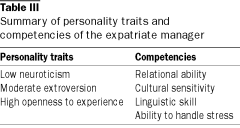
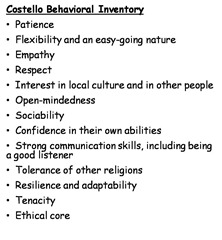
Caligiuri (2000) has recently studied expatriate adjustment using the “Big Five” personality traits (Goldberg, 1993 defines them as those which account for a majority of the variance in personality measures):
Caligiuri’s results suggest that Extroversion, Agreeableness, and Emotional Stability are traits most positively related to expatriate success. Yet I would think that they would also be those most related to success in the home environment.
So, my question remains:
What are the personality traits that distinguish those who sojourn from those who stay at home?
In the Big Five context, are they people who are more dissatisfied (neurotic, perhaps, but wouldn’t that also make them less successful abroad?), or people who might have the easiest transition (openness, but why would they leave home?) .
Or perhaps some secondary characteristic, like confidence and curiosity, that isn’t part of the Big Five?
Or perhaps it’s determined by social context rather than personality type?
Note: If you want to read further, Rutgers maintains a public archive of Dr. Caligiuri’s papers and other related HR topics.
 Today has been a tough day for solving problems.
It’s not that the problems are inherently hard, but that they are intrinsically large. That means that they take time and fill the day, yet fail to close with a final solution.
Riding along the riverbank in the early summer sun to take a break, I reviewed my strategies. I must be making this harder than it needs to be. There are the inductive “Sleep on it, ignore it, wait for your subconscious to deliver a miracle” approaches; there are avoidance strategies like “Time will solve it, a bit of benign neglect will help, why not delegate”.
But if its my problem, then I only have two deductive strategies: appeal to principal or decompose to simpler chunks.
Divide and conquer is usually my approach, but I decided to try the alternative, appeal to a higher power, and called a friend working with startups in the entrepreneurship programs at MIT. He’s got a lot of practical experience and runs his own consulting business, so I feel like we share a lot of the same experiences.
On the positive side, he thought that the analysis and actions I’m taking are largely the right ones. My focus and task prioritization seemed right, and I hadn’t overlooked many things that needed to be in the mix. The UK project, in particular, seemed well defined and things were appropriately delegated: I’d just need to hang in and see it through.
My concerns about the Dutch business, that consulting was overwhelming development, and that I was spending too much time working for the business rather than letting it work for me, were more true. Part of the solution is to accept that consulting work cycles through peak and trough workload, and to be willing to push some tasks off into the coming quiet times without guilt.
The other was to be careful about respecting the boundary between consulting and contracting. I tend to be very hands-on, doing real work of analysis and reports, yet estimating time and pricing results as though I was simply and conversationally advising and connecting clients. In the future, I have to get the right distance and value set for each job and respect the scope of the tasks. Where “I’m here to help” was often the right stance in the corporate world, it invites mission creep as an outsider.
I do think it’s important to have a mastergroup or advisory board to turn to for occasional encouragement or reality checks in running a business. It’s probably especially important as an expat, where the social isolation is more pronounced. It won’t stop my having the occasional bad day, but it will help to keep things in perspective through the rough times.